The Question
There's a version of the near future where designers don't drag, click, or draw frames anymore. AI generates layouts from intent. Voice replaces cursor. The physical choreography of design work — the muscle memory of option-dragging a component, the rhythm of cmd-Z, the pause before a decision — disappears.
What if we could preserve that choreography before it's gone?
Not as a screen recording. As art.
This question came from a specific moment. I was working in Figma, moving objects around, and I noticed the pattern my cursor was tracing. It wasn't random — it had rhythm, intention, hesitation. It was a kind of drawing I was already doing, just one nobody could see.
Drawell makes it visible.
How It Works
You pick any window on your Mac. Set a timer: 5, 10, or 25 minutes. Drawell watches — silently recording mouse position, velocity, acceleration, keyboard events, and pauses. When the timer ends, it renders a single artwork from that session's data.
Each input dimension maps to a visual quality:
- Speed → stroke width and opacity
- Acceleration → trajectory and splatter
- Pause/dwell → ink pooling, water stains
- Keyboard rhythm → texture and pattern
Five rendering styles across two series:
Traditional Media Series
- Ink Wash — wet-edge brush strokes, flying white (飞白), ink pooling where the cursor lingers
- Watercolor — layered transparent washes, color bleeding at intersections
- Charcoal — rough grain, pressure-sensitive marks, smudging on slow movements
Artist Series
- Mondrian — geometric decomposition of the cursor path into primary-color rectangles
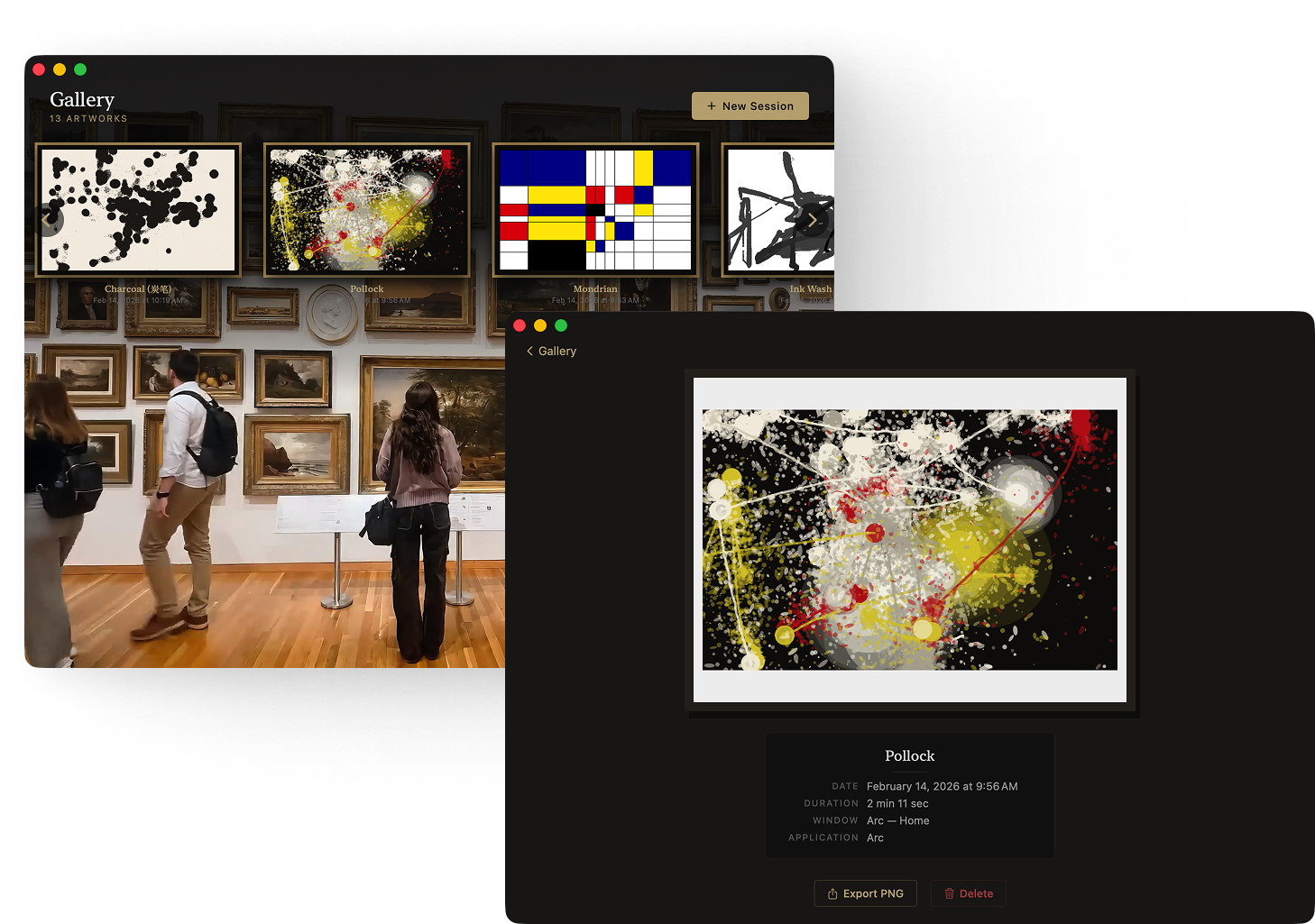
- Pollock — splatter physics based on acceleration, drip patterns from pauses
The same behavioral data, five completely different interpretations.
The Gallery
Every artwork lives in a built-in gallery — dark museum aesthetic inspired by the British Museum. Each piece shows its metadata: which app was being used, how long the session was, which rendering style was applied.
The design language: dark background, generous spacing, artwork displayed like exhibits. The gallery itself is part of the statement — these aren't throwaway outputs. They're artifacts of creative labor that would otherwise be invisible.
Technical Architecture
- Capture layer: CGEvent tap for global mouse/keyboard monitoring, running on a dedicated high-priority thread
- Data pipeline: Raw events → smoothed trajectories → normalized behavioral features
- Rendering engine: Core Graphics-based, with style-specific shader logic for each rendering mode
- Menubar integration: Lives in the macOS menu bar. Start/stop recording, set timer, view gallery — all without opening a main window
- Privacy: All data stays local. No network calls. The app only watches the window you explicitly select.
The hardest technical challenge was the rendering fidelity. Ink wash, for example, needs convincing wet-edge behavior — the way ink bleeds unevenly along the stroke edge, the way it pools in concave areas. This requires simulating fluid dynamics at a simplified level, not just drawing thick lines.
Where It Is Now
Feature-complete. The capture pipeline, rendering engine, gallery, and menubar integration all work. I use it myself — recording design sessions in Figma, coding sessions in Cursor, even writing sessions in Bear.
The current focus is rendering quality. The gap between "this looks like generative art" and "this looks like it could be real ink wash" is where the interesting work is. Each style has reference images from actual traditional media, and I'm iterating to close that gap.
It's unfinished, and I'm okay showing it that way. The interesting part isn't the polish — it's the question it asks about what we lose when our tools evolve past us.
Why This Matters
Drawell isn't a productivity tool. It doesn't make you faster or more efficient. It exists to ask a question: what does it look like when a human designs?
Not the output — the process. The hesitation before a decision. The burst of speed when you know exactly what you want. The circling, the backtracking, the rhythm.
As AI takes over more of the mechanical aspects of design, these behavioral signatures become the last truly human layer. Drawell is an attempt to make that layer visible before it fades.